Tray and Cavity Fit
Submit cavity width, depth, taper, drainage opening and dimensional tolerance. Dry and hydrated fit can then be checked against the selected CF model.
A buyer-ready disclosure framework for MCCS molded coconut coir and peat substrate plugs. Review which properties are published, which require a current batch report and which must be validated against your tray, irrigation and automation settings.
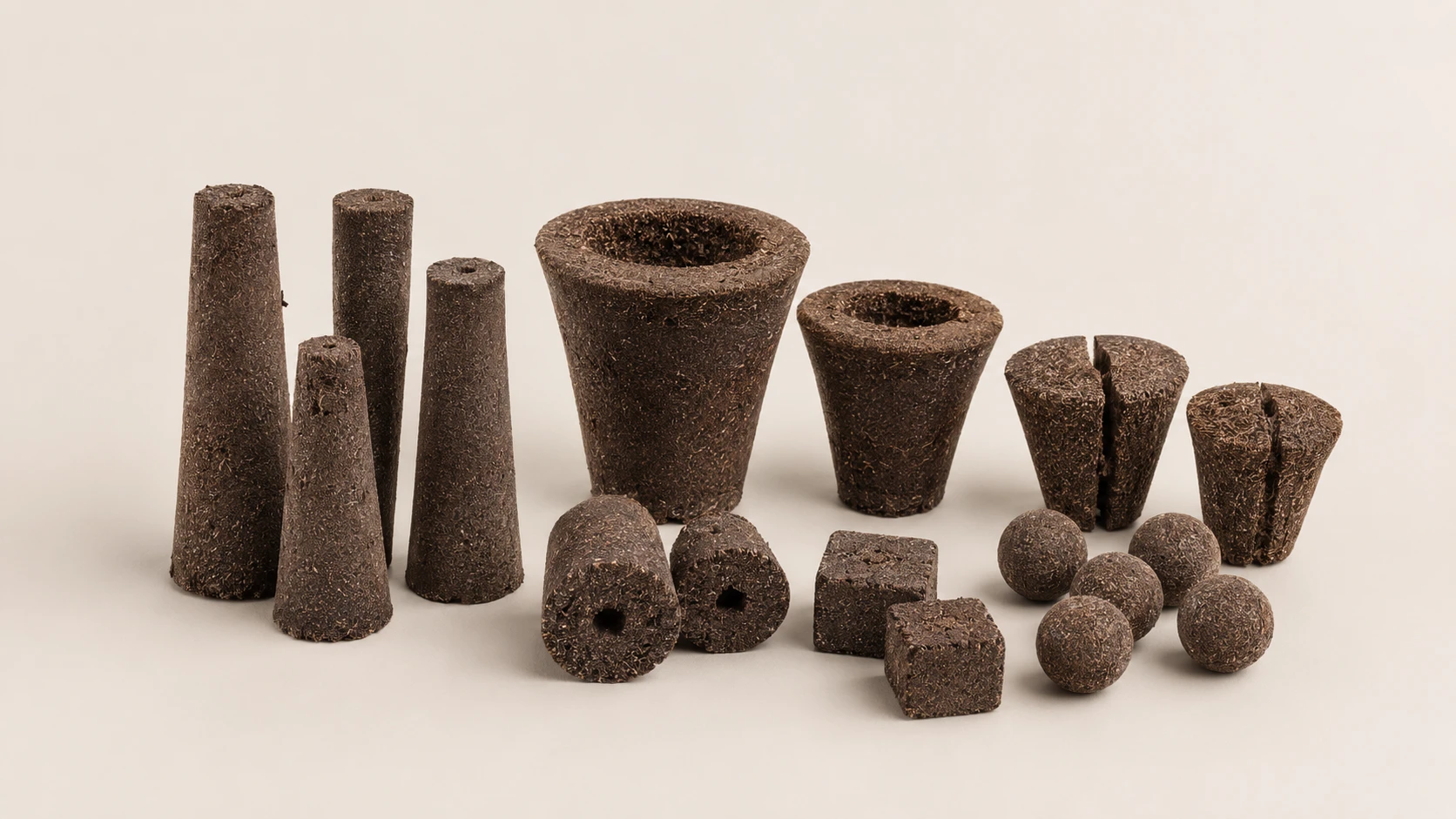
Values are only stated as universal specifications when supported by an approved source. Batch-dependent and application-dependent fields are labeled so procurement teams can request the correct evidence.
| Property | Disclosure | Test or Validation Basis | Buyer Action |
|---|---|---|---|
| Material composition | Published Molded coconut coir and peat substrate with adjustable plant-fiber binder ratio. | Final formulation is project-specific. | Share crop, tray, irrigation and handling requirements. |
| Dry density | Batch report No universal density is published. | State dry basis, specimen volume and conditioning method. | Agree the method before requesting a value. |
| Wet density | Batch report Moisture condition must accompany the result. | Record saturation, drainage time and sample geometry. | Provide target handling moisture and tray format. |
| Air-filled porosity (AFP) | Sample trial Model and protocol dependent. | Use an agreed saturation, drainage and calculation method. | Define target AFP and root-zone operating range. |
| Water-holding capacity (WHC) | Sample trial Model and protocol dependent. | State sample volume, saturation and drainage conditions. | Validate against irrigation interval and crop demand. |
| Water-to-air ratio | Sample trial Calculated from agreed AFP and WHC results. | Use the same specimen and protocol for both inputs. | Set an acceptance window with the grower or agronomist. |
| EC value | Batch report Current-batch result available by agreed scope. | Extraction ratio and water quality must be stated. | Specify the required method, such as a 1:1.5 extraction. |
| pH range | Batch report Current-batch result available by agreed scope. | Extraction method, soak time and temperature must be stated. | Provide crop and nutrient-program acceptance range. |
| Sodium (Na+) and chloride (Cl-) | Batch report Exact ppm values are not presented as universal claims. | Include ions in the agreed analytical scope and report units. | Request the applicable report for the proposed batch. |
| Buffer or wash treatment | Project specification Treatment status is confirmed per quotation or batch specification. | Do not infer treatment from a generic product family description. | List required treatment and acceptable residual ions. |
| Rehydration under pressure | Sample trial No universal time is published. | Record model, pressure, emitter pattern, water temperature and wet dimensions. | Provide the target pressure and maximum cycle time. |
| Mechanical strength and crumble rate | Sample trial No universal gripper threshold is published. | Test at target moisture, jaw geometry, pressure and cycle rate. | Share automation settings and an acceptance threshold. |
| Particle-size distribution | Project specification Formulation-specific. | State sieve method, fractions and conditioning basis. | Request the distribution for the approved formulation. |
MCCS supports technical sample review for commercial propagation workflows. Compatibility is confirmed against the buyer's equipment and moisture window, not assumed from the product family name.
Submit cavity width, depth, taper, drainage opening and dimensional tolerance. Dry and hydrated fit can then be checked against the selected CF model.
Provide jaw profile, grip pressure, dwell time, line speed and target moisture. Sample trials can record visible damage, crumble loss and transfer consistency.
Confirm bottom clearance and drainage geometry with the actual tray drawing. Air-pruning behavior requires crop- and system-specific validation.
MCCS separates available evidence from certifications or performance claims that have not been published. Certifications and technical thresholds are presented only when the applicable document and scope can be reviewed.

Manufacturing-partner SGS SVHC screening and an MSDS are available for the common substrate material system used across CF models. The SGS result applies to its tested sample; request current documents before using any claim.
Request applicable documentsUp to 100,000 individual molded substrate units per day under full-line operation. Actual output depends on model, packaging and production schedule.
Technical fields can be assigned to an agreed report, specification or sample protocol. A universal value is not substituted for current evidence.
A 2025 Agronomy PFAL study covers the common MCCS substrate material system used across CF Series formats under its stated lettuce and pak choi conditions. It is not a model-by-model certification or universal performance guarantee.
Review the published study by DOIUse this format-level table for initial sourcing. Final dimensions, carton references and MOQ remain model-specific in the catalog.
| Format | Dimensions | Application Scenarios | Air Porosity | Target Crops | Packaging / MOQ |
|---|---|---|---|---|---|
| Tapered and square propagation plugs | Model-specific compact profiles; compare CF Series dimensions in the catalog. | Propagation trays, hydroponic holders, PFAL and nursery transplanting. | Formulation- and protocol-specific; request AFP validation. | Vegetable seedlings, cuttings and tissue-culture transition. | Model-specific reference carton quantity and MOQ; confirm with sales. |
| Orchid and specialty growing cups | Model-specific larger-volume tapered formats. | Stage-based transplanting and larger containers. | Project-specific; validate drainage and irrigation interval. | Orchids and specialty young plants. | Model- and packaging-specific; confirm the applicable quotation. |
| Staghorn fern mounting forms | Model-specific decorative round profiles. | Display trays, hanging baskets and specialty retail programs. | Not presented as a universal value; validate by format. | Staghorn ferns and epiphyte mounting concepts. | Lower-count format; confirm carton plan and MOQ by model. |
These answers distinguish suggested test conditions from published product claims, helping procurement, growers and equipment teams build a defensible approval protocol.
MCCS does not publish one universal rehydration time because model dimensions, formulation, initial moisture, water temperature and emitter coverage change the result. A 1.2 bar test can be included in a sample protocol, with time to full wetting and final wet dimensions recorded for the selected model.
A universal below-0.5% crumble guarantee is not published. Buyers should provide gripper geometry, pressure, cycle rate and target plug moisture. MCCS can then agree a sample handling test, including the proposed 55-65% moisture window, before a bulk specification is approved.
No universal 36-42 hour claim is made. Wilting depends on crop stage, root mass, radiation, humidity, airflow, nutrient EC, initial saturation and block geometry. The buyer should validate the selected format under the actual greenhouse climate and irrigation strategy.
MCCS does not publish a universal below-4% vertical AFP gradient. AFP results require an agreed saturation, drainage, sampling and calculation method. A top-versus-bottom comparison can be requested for a selected model and formulation.
Exact sodium and chloride ppm values must come from the applicable batch or project report. Buffer or wash treatment is confirmed in the approved quotation or batch specification; it should not be inferred from a generic product-page claim.
MCCS does not publish a universal plus-or-minus 0.2 drift guarantee. The result depends on water alkalinity, extraction ratio, soak time, temperature and formulation. Buyers can request an agreed pure-water soak protocol with starting and final pH recorded.
No universal 18-month claim at 85% relative humidity is published. Storage guidance and any project-specific shelf-life statement should be confirmed for the packaging format, warehouse temperature, humidity control and pallet protection used in the shipment.
MCCS does not state a universal 10-layer or below-1.5% retention claim. Pallet configuration, carton strength, compression duration, route climate and product format must be reviewed together. Shipment-specific packing and load plans are coordinated before dispatch.
Tray standards vary by manufacturer. Buyers should submit the cavity drawing, drainage opening and target plug model. MCCS can check dry fit, hydrated fit, drainage clearance and root-zone handling during sample review before bulk ordering.
No universal three-cycle decay rate is published. Reuse performance depends on crop duration, root loading, sanitation, irrigation chemistry and mechanical handling. Buyers planning reuse should run a multi-cycle trial and define density, AFP and structural-retention checkpoints in advance.